

Quartz
Quartz
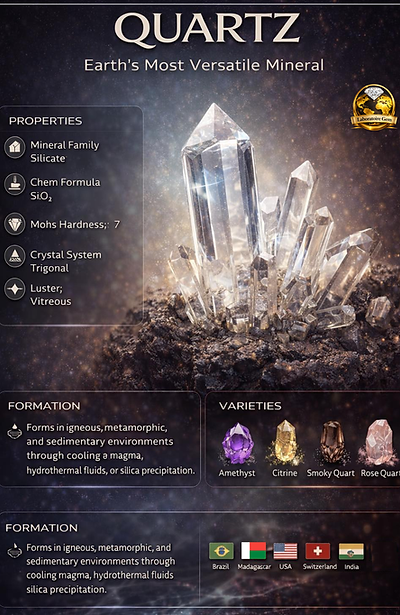
Quartz is one of the most abundant minerals in the Earth's crust, composed of silicon dioxide (SiO₂). It most often crystallizes in hexagonal prisms and is distinguished by a hardness of about 7 on the Mohs scale, making it very resistant to wear. Its large "family" of varieties arises primarily from minute impurities (iron, aluminum, titanium, etc.), inclusions, and sometimes natural effects of irradiation or heating that alter its color. Clear quartz, or rock crystal, is the purest and most transparent form, often used to admire the crystal's natural geometry. Amethyst owes its purple color to traces of iron and natural irradiation, while citrine displays yellow to orange hues, sometimes naturally occurring, sometimes obtained by heating other quartz crystals.
Smoky quartz, on the other hand, acquires its brown to gray-black hue from colored centers linked to irradiation, often in the presence of aluminum in the crystal lattice. The pink variety generally owes its color to specific inclusions or crystalline defects, which explains its sometimes milky rather than perfectly transparent appearance. Another spectacular variety is aventurine, recognizable by its sparkling flecks due to small inclusions (for example, mica) that reflect light. We can also mention agate, chalcedony, and onyx, which are microcrystalline forms of quartz: their crystals are so small that they create ribbon-like textures and highly varied patterns. In some quartz crystals, needle-like inclusions (such as rutile) create golden "hairs," transforming the crystal into a veritable mineral landscape.
From a scientific perspective, quartz is also renowned for its piezoelectric properties: when subjected to pressure, it can generate an electrical voltage, which has been used to stabilize frequencies in numerous devices. For maintenance, most quartz crystals are easily cleaned with warm, soapy water, but some colored varieties may fade if left in the sun for extended periods. In short, quartz is a stone that is both common and astonishingly diverse: a single chemical base, yet an infinite number of shades created by nature.